UPDATE: THE PEOPLE TAKE ACTION TOOLKIT HAS NOW BEEN ABSORBED INTO THE EARTH TALK BOOK, TRAINING COURSE AND ONLINE COMMUNITY
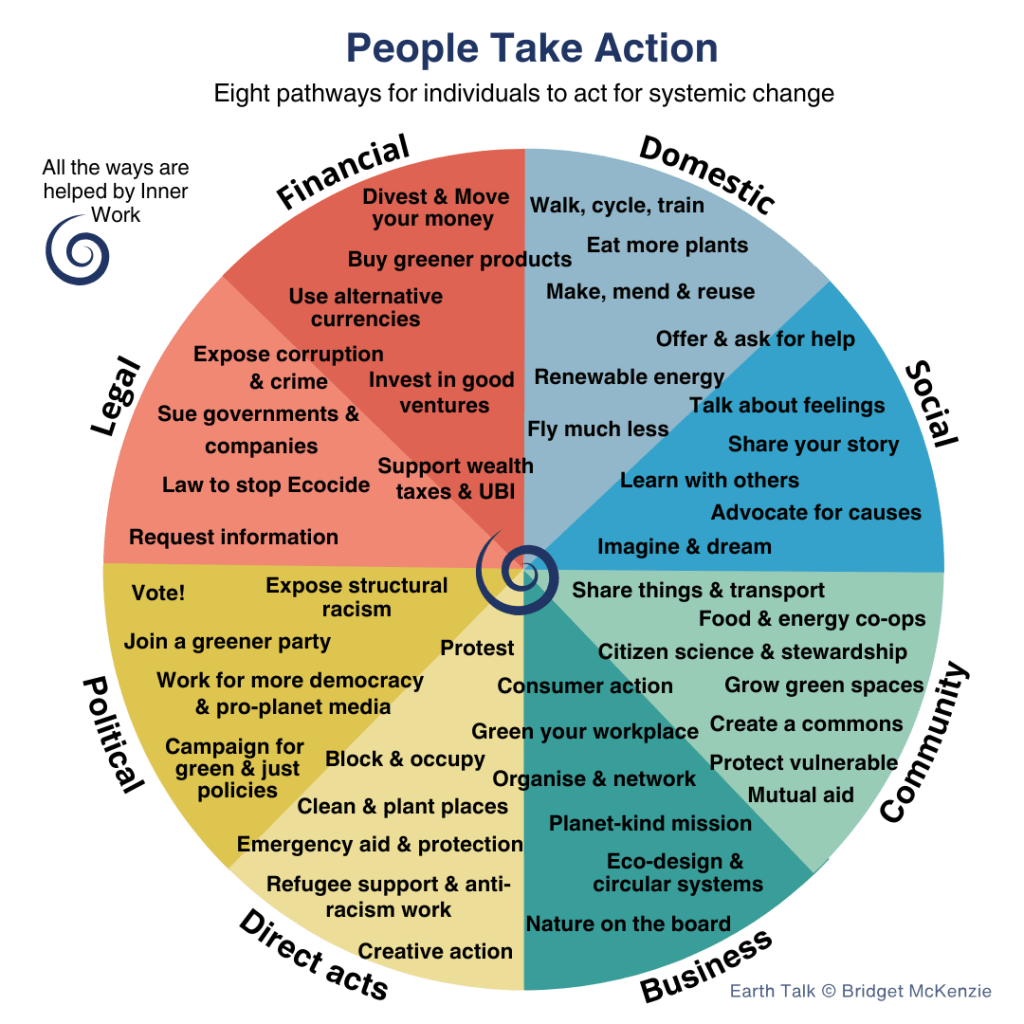
This framework that I’ve developed as a tool for Climate Museum UK offers eight pathways for people to take action on the Earth crisis in any area of influence they have. It aims to expand thinking about what action is possible, seeing all actions as ‘personal actions’ within our blended lives as consumers, friends, citizens and workers.
You’ve seen those lists of easy things you can do? You see them at the end of news reports on climate breakdown or on biodiversity campaign sites.
Do they make you feel better, as they’re supposed to? Or do you feel overwhelmed? Maybe you already do most things on the list and you know about the rest. Perhaps you’re involved in a group, campaign or local community action and you want something to motivate and challenge people. Or, do you get frustrated with limited ideas about what action is possible? These limited ideas lead to binary arguments such as “personal lifestyle action versus big system changes”.
The 8 pathways to action are also complemented by the Inner Work spiral, based on the Inner Development Goals.

I’ve been using this framework in Climate Museum UK workshops for effective change in groups and communities. Get in touch on climatemuseumuk@gmail.com if you are interested to learn more.
I have also included a DIY workshop tool using this framework in my forthcoming book ‘Earth Talk’.
It’s informed by four principles:
Being authentic: Every sphere of influence — at home, at work, in neighbourhood groups or in governments — is made up of individual people who can make choices and changes. If we face the truths of the Earth crisis, we can act with authenticity and passion. If we find out how we can make our best contribution, we will be lifted with motivation and lift up others too. If we focus on our authentic relationship with the places we inhabit and our fellow inhabitants, we are more able to respond to immediate needs in effective ways. There is nobody but ourselves!
Being collaborative: People need to work creatively with others to discuss, discover and develop ideas for action. People are not motivated when presented with lists of tasks, or scientific facts. The People Take Action framework works best when you get together with people, share learning and explore what initiatives already exist that need support. Let’s work together!
Being Possitopian: This is an approach to future thinking that expands the cone of the possible future. It draws on both physical realities and the imagination to help us think about future scenarios which are potentially worse or better than we might normally allow ourselves to think. It shows how we have Earth Crisis Blinkers, and aims to expand our thinking about what’s really happening, and therefore what the solutions can be. Let’s imagine!
The Regenerative Flip: We have to hold in our minds the possibilities of a world in which the planet, places and people are all thriving. This helps us be ready to flip others’ thinking in any situation, to show the harm in our normal ways of being, and to explore the alternatives. Know what’s wrong and show what’s possible!
The People Take Action framework emerged alongside my Culture Takes Action framework, which is aimed at the Cultural sector. I realised there was a need for structured tools to help us engage with people in places, in all kinds of organisations and communities of interest, not just in the Cultural sector.

 Climate Museum UK
Leave a comment