Welcome to our Summer newsletter, one of our quarterly newsletters planned around the solstices and equinoxes of the year.
The Summer Solstice is the day when the Northern Hemisphere is bathed in sun for the longest amount of time all year. And it’s shaping up to be a hot one. This is an El Nino year, so the warming and disruptions to the climate are going to be exacerbated, and we’ll see worsening drought, heatwaves, wildfires and storms. This is not an easy time to read environmental news – when mainstream news continues to sideline such issues, but campaigners and researchers tell us that the first stage of abrupt climate catastrophe has already begun.
This newsletter includes both a provocation and some news updates, giving a small insight into a few of our activities as we continue to hope that our creative connections can help to build a more positive future.
Shifting Narratives and Frames

Provocation by Bridget McKenzie
You may have noticed we use the term ‘Earth crisis’. We’ve been having some conversations on how to use language with people that is meaningful for them but which is also more accurate.
One of our principles is being holistic in our framing of the crisis, and the term ‘Earth crisis’ is an attempt to expand thinking to all nine of the ‘Planetary Boundaries’, including climate change. So we try, as a collective, to be precise with our terms. It’s important to clarify between climate specifically and the wider Earth crisis, and not to use climate change as a cover-all term. We acknowledge that it is the biggest emergent wounding of the biosphere that multiplies the threats from all the other factors. However, if we have a limited focus on climate, we are less able to see historical and colonial roots of ecological damage and also less able to see potential solutions or systemic changes. Read this for more about the idea of Earth Crisis Blinkers.
This framing also helps to locate social injustices such as global income inequality and the UK’s ‘cost of living crisis’ within this wider framing of an extractive and exploitative system. It can be considered unsympathetic to try to get people to think about environmental issues (i.e. an expanded frame in time, place and perspective) when they are struggling with immediate problems. Read this for 13 points on why tackling environmental issues is the most compassionate thing we can do for people facing injustices and immediate struggles. And download my People Take Action toolkit if you want to work with people to grow their agency to take action whatever their situation.
Finally, the Earth crisis framing helps us expose the relationship between histories of colonialism and the current crisis. Land-grabbing, poaching, wars over resources and the displacement of people, for example, are all continuations of supremacist violence begun centuries ago.
For more, you can read, or contribute to, our Stories of Extraction enquiry. (Find all stories via the archive.)
If you would like to contribute views in response to this provocation, please get in touch on climatemuseumuk@gmail.com or tag us on Instagram, Twitter or Facebook.
Goldsmiths Partnership: Eco Art Learning Website
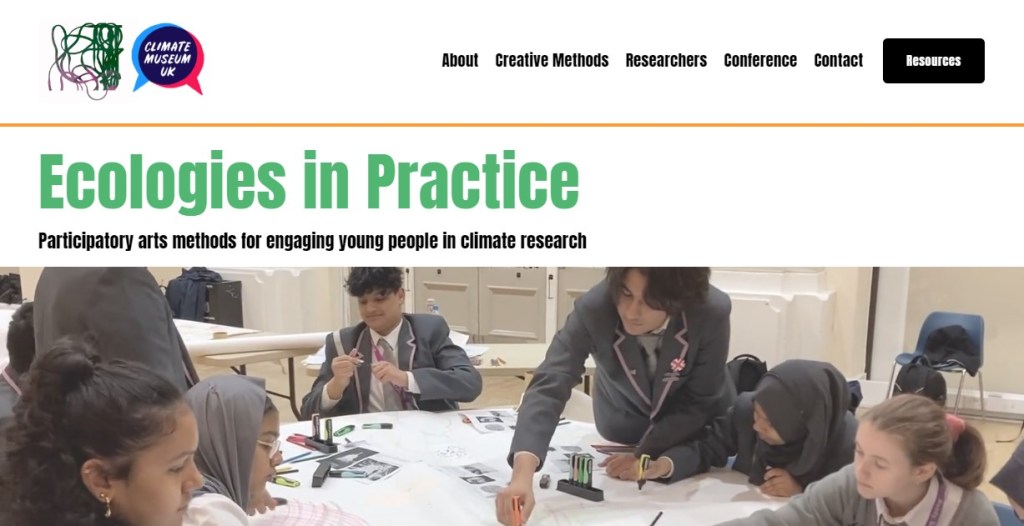
We’re at the final stage of our partnership with Goldsmiths, exploring arts-based methodologies for engaging young people with climate & nature.
We’re pleased to announce the launch of the project website www.ecoartslearning.net.
It captures the three arts-based methods we used, and offers learning resources and further insights into the enquiry.
The site was designed and built by our associate, Jess Farr (who also looks after these newsletters!)
Ecologies in Practice Conference

Image by Kimberley Foster
‘Education, the Arts and the Earth Crisis’ on 13th-14th July 2023, Goldsmiths
We will also take part in a two-day in-person conference ‘Education, the Arts and the Earth Crisis’ on 13th-14th July 2023. Can learning how to position responses to the crisis, and how to act to disrupt the root causes of extractivist and colonial practices help to create system change? What is the role of arts-based learning for reparative action in local, global and more-than-human communities? What are the possibilities of inviting people with diverse perspectives into ecological arts practices and sustainable learning?
You are invited to come along if you can: find out more and book here.
More Useful Guides and Tools
- People Take Action toolkit – Offers eight pathways for people to take action on the Earth crisis in any area of influence they have.
- Imagine Futures – A resource to help young people dream possible futures for themselves and their places, as well support educators, cultural workers and community leaders run a very similar workshop or develop their own project.
- Community Climate Action Toolkit – A community level resource supporting groups to understand their local situation and take meaningful action on climate change. Supported by the Schumacher Institute.
Emerging Practitioners
The Emerging Practitioners network and programme aims to provide funding, training, work, and support for young individuals eager to critically explore the potential for ‘eco-social art’ to create a re-generative culture. Until we succeed in a substantial funding bid to support several paid placements, we invite you to donate to our crowdfunder, to allow our network members to carry out their own small projects.
London Cultural Assembly: Together We Act

Sun 3 Sep, 2pm at The Clore Ballroom, Royal Festival Hall, FREE
We’re excited about this event in collaboration with our friends, Culture Declares Emergency and Letters to the Earth. Part of Planet Summer at the Southbank, and linked to the Dear Earth exhibition at the Hayward Gallery. More info here
News from our Associates around the Country
James Aldridge
Drawing on Water exhibition, 20th July to 26th August at Pound Arts Centre, Corsham, Wiltshire

This exhibition brings together work in a variety of media, created by James through his Queer River research project. Drawings, photographs and films reflect on the process of coming to know rivers and other wetlands, through collaborative, creative and embodied practices, to understand what they need from us, and what we can gain in return.
Creative River Walk, Byde Mill Brook, Corsham, Wiltshire – 10.00 a.m to 1.00 p.m on Wednesday 9th August. Booking is now open.

Meet James at his exhibition Drawing on Water at the Pound Arts Centre, to hear more about how he walks and makes beside Wiltshire’s rivers, before leaving to explore the nearby Byde Mill Brook. Together we will use creative mark-making techniques to record what we notice about the Brook, think about how it has been changed by humans over time, and discuss what it needs from us in the future.
Kevin Davidson

Copyright Daybreak, Mads Berg
Kevin is exploring Regenerative Games and playful approaches through a number of projects, including our Goldsmiths partnership. We recently ran an open meeting exploring climate games, with game designer Matteo Menopace, and Kevin has written this review of Matteo’s Daybreak game.
Possitopia Norwich

Bridget McKenzie has been busy setting up the local programme under the CMUK umbrella, working with other associates local to Norwich.
Highlights include:
- Working on a Lottery funding bid with Norwich Climate Commission and other partners.
- Climate Museum UK is part of a consortium with Norwich Eco Hub looking to find a shared building, which would be the first visitable base for our organisation, in Norwich.
- Planning a Possitopia Norwich festival of workshops for local associates and friendly organisations
- Walking in the Shoes walkshop to imagine the green, healthy future of Norwich, inspired by characters from its history. July 9th, 3.00, free.
- Climate Stories Late, Norwich Theatre, July 21st, 6.00 – 9.30. Bridget with others will have created a soundscape, video and participatory installation as part of this event, a strand of the Theatre’s Climate Stories season.
- Advisory role towards a 3 day R&D workshop on ‘Eco-anxiety through performance’, with Simon Floyd and other partners, at Norwich Theatre, 28-30 July
- Norfolk members of Climate Museum UK held a pop-up museum activation as part of Norfolk’s Healthy Environment Day, on June 10th. We invited participants to create artworks imagining the green future of the City, and to pledge what they would do if they knew they could not fail.
Katrin Spranger
1.8 Co-Create, K2 Academy of Contemporary Jewellery, London, April-July

Katrin Spranger has brought together eight fellow artists and makers for a collaborative adventure to create work that takes its inspiration from the plastic waste that is causing a global environmental crisis; creating beauty from destruction, while also serving as a call to action. The prototypes and samples are work in progress that will ultimately become sculptures, jewellery, fashion pieces and art installations.
The project, entitled 1.8, takes Katrin’s earlier performance artwork of the same name in new directions. The figure represents the unsustainable amount of litres per day of fossil fuel oil we each consume.
Ann Borda

The Donnie Creek fire in northeastern B.C. (B.C. Wildfire Service)
Finally, from beyond the UK, our new associate Ann Borda is currently living in British Columbia, Canada. She has written a post for our Extreme Weather Stories blog, about Living with Wildfire.
As part her association with UCL and digital humanities, Ann has also been exploring a set of immersive virtual climate exhibitions (international, including UK) and the extent to which they promote learning and pro-environmental attitudes and behaviours. Her research will be embodied in a conference presentation at EVA London 2023, July 10-14.
 Climate Museum UK
Leave a comment