Before I sat down to write this I dropped my son off at a holiday club for a day of canoeing on the Kennet and Avon Canal in Devizes, Wiltshire. He’s a 12-year-old boy, with two dads and African-Carribean heritage. You might be wondering what this has to do with Blue Health and Climate Breakdown, and indeed what is meant by Blue Health.
‘The concept of blue health emerged almost 10 years ago when researchers at the University of Sussex asked 20,000 people to record their feelings at random times. They collected over a million responses and found that people were by far the happiest when they were in blue spaces.’
The surprising benefits of blue spaces, BBC Future Planet
I’ve been exploring access to and perceptions of rivers and other wetlands for the past 3 years, or so, through my Queer River research project. As part of that research I’ve looked into the links between the Kennet and Avon and slavery (Hidden Histories: Walking the Kennet and Avon Canal with Andy Marks), and written this piece on access to blue spaces for British Canoeing. So, dropping him off there today links all sorts of watery threads together in my mind.

One of the reasons that I set up Queer River was because of my increasing awareness of the subject of climate justice, supported through discussions among the Climate Museum UK team, with whom I’m an Associate Artist. I wanted to explore climate justice and access to blue spaces from the perspective of a Queer man, and to explore what Queer perspectives can offer the envonmental/climate movements. You can read more about that in this post – HIV/AIDS and The Earth Crisis and in a piece written after working with the University of Glasgow on the Queer River Wet Land project alongside COP26
Looking back on my time spent walking, talking and making with others along rivers and canals, it’s clear that as well as seeking to learn from the perspectives of my collaborators, I also shaped the project to support my own wellbeing. I began to explore my neurodivergence, and to work out what I needed to stay well (see Neuroqueer Ecologies).
‘From the early Greek and Roman physicians who recognized the healing powers of nature and bathing; to stressed out industrial workers in the nineteenth-century England and the United States who were advised to ‘take the waters’ by the seaside…to men and women today who treat their drug and alcohol addictions or PTSD with the dopamine rush of surfing… all these are examples of how water can help us transition to the healthier Blue Mind state of calm centredness.’
Blue Mind – Wallace J Nichols
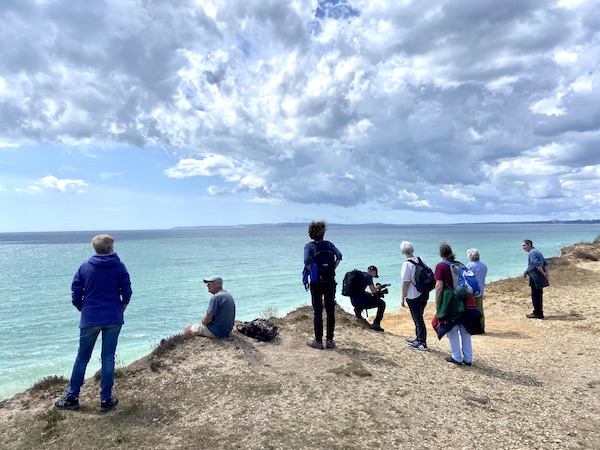

I’m a big believer in the health benefits of experiencing our place within natural systems. In my arts practice, art is used as a way of focusing on our embodied, emotional and imaginative relationship with places, and one of the benefits can be an improvement in mental health, through feeling connected and supported. I do, however, have a bit of a problem with some of the language used in Green and Blue Health contexts, and what that says about our perceptions of our place within those systems.
When we talk about ‘visiting nature’ or ‘spending time in nature’ for example, what is it we are actually saying? To me it sounds like we are starting from a point of division, or separation. It is this division, I believe, that caused the climate and ecological crisis in the first place. If we visit ‘Blue Spaces’, seeking to benefit from time spent in them, we can feel reconnected, but isn’t that a bit one-way/extractive? What do the watery ecosystems, the communities of life that make up rivers, lakes and coastlines get in return?
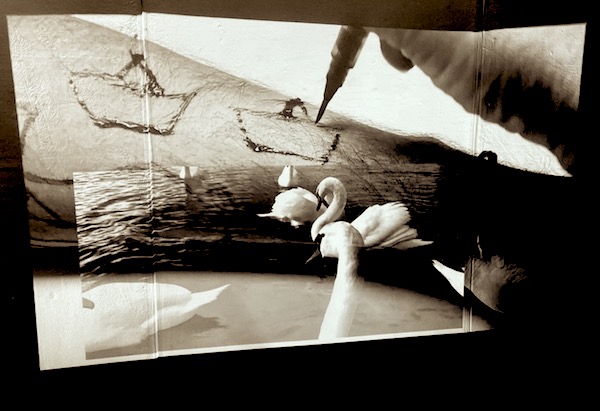
In 2021, partly as a result of my Queer River research, I set up and began working on The Ripple Effect (The Ripple Effect: Blue Health with Wessex Archaeology) in partnership with Leigh Chalmers, Wessex Archaeology’s Heritage Inclusion Manager. Leigh and I had noticed the publicity surrounding the planned Salisbury River Park Project in Wiltshire, whereby the River Avon as it passes through the city is to be given more room to flood, and biodiversity increased through swapping concrete and sluice gates for bankside vegetation and fish ladders. We developed a project idea in response, exploring the Avon’s past, present and potential future, its ecology and archaeology, and invited a group of participants with some form of mental health need to take part in two years of creative river exploration.
I was keen that through The Ripple Effect sessions, we would explore the interelationship between individual and ecological wellbeing. The works in Salisbury plan to enrich the biodiversity of the river corridor, while increasing access to Blue/Green space for visitors and local people. The river will be given room to flood into marshy areas in times of heavy rainfall, rather than the flooding impacting on shops and houses.
Artist/Researcher Rachel Clive, who has carried out related research into the relationship between geodiversity and neurodiversity in the context of participatory practice with rivers, writes:
‘Freedom Space For Rivers thinking is an approach to river/ flood risk management which seeks to work with rivers as they respond to a changing climate, rather than against them. It acknowledges that there are urban areas in which hard engineering approaches are necessary but advocates, where possible, for “more space for rivers to migrate and flood naturally” (Biron et al, 2014). When rivers have the freedom space to find their own way, they enrich the environment and nurture biodiversity in the process.’
For Freedom Space with Rivers – An Intergenerational Arts Project, Rachel Clive
Together, Leigh and I decided that we would look at how the path of the river has been altered over time, and how river restoration in this and other settings seeks to give rivers back some freedom and agency, and the space they need to rise and to fall.


I recently shared my work on Queer River and The Ripple Effect with Year 3 medical students at The Bristol School of Medicine, alongside Artist/Researcher Dr Catherine Lamont-Robinson. The students have been working on a Blue Health project entitled At Sea with Disability & Blue Health: ecological, embodied and global perspectives, co-developed and led by Dr Alan Kellas and Dr Catherine Lamont-Robinson.
During my time with the group, I invited each student to spend some time with their local river, using creative methodologies to record what they noticed. I’m hopeful that this work will not only support the student’s own wellbeing, but expand their sense of what is possible in terms of social prescribing, and the value of creative, embodied experiences of Blue Spaces for staff and patients. (You can view short video clips of me sharing similar river based creative activities here as part of Ebb and Flow with Wessex Archaeology. I also used these previously with participants as part of an Acts of River Kindness project with Climate Museum UK).
Similarly to Blue Health, at first glance the concept of Blue Mind seems to focus solely on the positive effects of being alongside/in water, as illustrated by the full title of the book by Wallace J Nichols – Blue Mind: How Water Makes You Happier, More Connected and Better at What You Do. I’m conscious that, taken in isolation, this could be seen as a priviliged position, with leisure time spent near water available primarily to those without financial, cultural or physical barriers. I’m also increasingly conscious of the impact of climate breakdown on weather and the water cycle, leading to drought and flooding, and the fact that many people may come to associate water with traumatic events that threaten their lives and livelihoods.
Much of what I hear people talking about in terms of the benefits of Blue and Green Spaces, comes from the sense of safety and predictability that they can offer. A river keeps flowing, waves keep lapping at the shore, tides come and go. Water lifts and cradles us in a pool or bath. But for how long can we rely on the watery reassurance that Blue Health/Blue Mind speaks of? How long until our local river becomes a threat, or crops fail due to drought?
To date, these events haven’t impacted me directly. My mental health has been affected, as I watch people being swept away by floods on the news, worry about my son’s future, and feel a greater sense of unease at the unpredictability of seasonal weather. I’m scared, but my local river continues to follow its course, my home is still intact, my work continues, and I’m lucky that for now I have access to a range of healthy food.

As the effects of climate breakdown worsen, and move closer to home, my thinking is changing and will continue to do so, but for now, here’s a few things that I think we need to consider when planning projects that seek the health and wellbeing benefits of being close to water:
- Let go of some of the romance of Blue Health/Blue Mind, to embed an understanding of climate justice within the learning. Be explicit about the unequal ways in which wetlands benefit or threaten us in a time of crisis.
- Try and remove as many barriers to accessing positive experiences of wetland environments as we can, and take into account people’s historic experiences of rivers, lakes or the sea. Be participant-led rather than using a top-down, one size fits all approach.
- Engage with wetlands with our whole being – our bodies, imaginations, emotions and more consciously too. This is what creative methodologies can provide us with, ways of being explorative, of reaching out to touch and be touched, recording our experiences and reflecting on them with others.
- Combine time spent alongside rivers and other wetlands, with an expectation that we take actions that benefit them in return. We have a duty of care to the ecosystems that provide us with life, health and wellbeing.
- Lastly, and this is kind of an amalgamation of all the above, we need to move from ‘spending time in nature’, to being and acting as nature. A river for example isn’t a linear strip of water, it is a community of life and we are a part of that community.
A few more links, with thanks to Dr Alan Kelas:
BlueHealth – BlueHealth is a pan-European research initiative that investigated the links between urban blue spaces, climate and health.
Healthcare Ocean – We aim to conserve and protect coastal and marine ecosystems through minimising harm resulting from the procurement and delivery of healthcare whilst increasing awareness of the benefits to human health and wellbeing from healthy seas, coasts, and waterways.
http://www.healthcareocean.org/
Ocean Generation – We exist to restore a healthy relationship between humanity and the Ocean (includes programmes for young people).
http://www.oceangeneration.org
River Action – Launched in 2021, River Action is on a mission to rescue Britain’s river by raising awareness on river pollution and apply pressure on industrial and agricultural producers, water companies, and other polluters.
Simon Hall, Coastal Tonic – A project exploring the historical relationship between healthcare and coastal waters. The work investigates local archival material and engages with community groups, alongside considering the legacy of human impacts upon the environment and future of the river Thames estuary.
http://www.simon-hall.co.uk/coastal-tonic
Voicing Rivers Through Ontopoetics: A Co-operative Inquiry – Peter Reason
How might we engage with the rivers through personal relationship, ceremony, and invocation? What are the possibilities for reciprocal communication? In short, how might rivers speak?
http://www.peterreason.net/wp-content/uploads/Voicing_Rivers_through_ontopoetics.pdf
The Universal Declaration of Rights of Rivers – http://www.rightsofrivers.org
 Climate Museum UK
Leave a comment