
Image: Woven fish by Love Our Ouse, overlaid on Sick River textile map by Lucy Carruthers
Welcome to our Autumn Equinox newsletter.
This newsletter celebrates the Autumn Equinox by reflecting on the back-to-school and conference season. As a collective, we are attending and contributing to many professional conferences and local learning events, so we are sharing some highlights here.
Climate Museum UK news
The Training we Deliver
We can deliver training sessions, usually online but also in-person for your group or organisation. These focus on understanding the Earth Crisis, putting an Eco Lens on your programmes and collections, and planning how you can contribute to a regenerative culture.
If you are an individual, you can join our Earth Talk programme. The next course runs from 23rd October weekly for 6 weeks. Join a Discover Earth Talk session on 26th September to find out more.
We also deliver training programmes that have been designed for our clients, such as:
CMUK’s ‘Green Narratives’ Training for Museums Development Midlands

The Green Narratives programme, developed and delivered for Museum Development Midlands, is well underway! Our Members, Clémence Aycard, Kathy Moore and Justine Boussard are now in the delivery phase of this training programme exploring how museums can harness their collections to respond to the Earth Crisis, from understanding the planetary emergency to looking at collections with an Eco-lens, exploring climate psychology, and designing appropriate displays and interpretation.
We are delighted to work with participants from 5 museum services: the Barber Institute of Fine Arts (Birmingham), Black Country Living Museum, Creswell Crags, Culture Leicestershire and Derby Museums. The next workshop on October 1st will be dedicated to object-based storytelling and how to draw original and meaningful environmental narratives from diverse collections.
Reports from Events
GEM Conference

Kathy Moore and Bridget McKenzie attended the Group for Education in Museums conference, with the theme “Sustaining Our Practice, Sustaining Our World.”
Together we delivered a workshop about the Generic Environmental Outcomes we have been developing with Bridget’s company, Flow Associates. The GEOs are modelled on the Generic Learning Outcomes used in museum & heritage learning for 20 years. Feedback from the workshop was positive: “This is a hugely valuable tool. Definitely needed. Helps focus on environmental issues and outcomes.” Participants felt they would be useful in advocacy, showing the value and relevance of museum learning for proactive change.
One interesting question came up: Should environmental outcomes be a sub-section under general outcomes, alongside other ‘topics’? Or are they actually all the learning outcomes anyone needs today, with every other topic subordinate to the Earth Crisis?
Bridget also gave a keynote talk, which she opened by shifting the framing of the conference to “Continuing the thriving of the living world through our practice, to sustain our practice”. You can listen to a pre-recorded version of this keynote here.
Climate Jam: Critical Decade for Climate Action Conference

Image: Lifecycle Bicycle by Hocus Pocus Theatre, at the Climate Jam
Bridget McKenzie and Kevin Davidson curated and facilitated the Climate Jam of this major climate research conference hosted by the Tyndall Centre at the UEA. The Jam invited 400 scientists and Norwich citizens to relax, chat and take part in creative activities that showcased local theatre companies, performers, musicians and artists. These included the Common Lot (with songs from their show From Mousehold to the Marsh), Hocus Pocus Theatre (with their Lifecycle Bicycle), Gossamer Thread Circus (with their piece Feral), the band Eat Your Greens and an installation of Shout Out by Jacqui Jones. There was also a ceilidh dance inspired by river ecologies, songs, nature canapes, an interactive timeline of climate history, and dancing with Grl Dem DJs.
Bodies of Water Symposium: Regenerative Art Practice

Image: Studio Air Jordan, with collage by Haigh Community Ambassadors
This symposium was co-curated by CMUK associate Justine Boussard and UP Projects, and it took place during the closing week of Liverpool Biennial in early September. It included discussions and participatory workshops dedicated to exploring regenerative practice in the context of public and socially engaged art, and to raising the ambition for what it means to be environmentally responsible – both technically and culturally.
Justine kicked off proceedings with some considerations for those on the journey towards environmental responsibility, which are detailed in the digital programme, including the need to challenge worldviews and to localise the work.
Bridget McKenzie led a workshop, co-facilitated with Danny Chivers (of the Gallery Climate Coalition) around actions towards a regenerative culture based on the three values of Culture Declares Emergency: Truth, Care and Change. Two big themes emerged from all the discussion groups: the need for time for expansive conversations and systemic change; the need for intergenerational conversations, and support for parents and children to engage with these issues.
James Aldridge led a walk titled Neuroqueer Ecologies Queer River research project, and the value that queer and neurodivergent experiences of ecosystems bring to discussions on regenerative practice.
Here’s some more from James and a blog post he wrote reflecting on his time in Liverpool, at the symposium and Biennial:
‘I’ve been doing a lot of processing since my walk with a lovely bunch of people from the Up Projects Bodies of Water symposium on Thursday. The theme of regenerative arts practice connected so well with my own arts based research on river futures, and my visits to Liverpool Biennial venues helped me to make connections to recent work on climate justice with Disability Arts Online and Climate Museum UK.
I’m conscious that many of my collaborators on Queer River walks have been white and I want to keep learning from Black artists and writers of colour on rivers and other watery places. This new blog post ‘A Taste of the of the Mersey: River Justice and Regeneration,’ shares the connections I’ve been making since I learned I was going to be working in Liverpool, and since I’ve come home again, linking rivers, regeneration and racial justice in relation to Liverpool and the Mersey.’
Creatively Connected, Arts, Farming and Nature Recovery in Teesdale and Swalesdale
Justine Boussard was invited to do some creative facilitation at Northern Heartlands Creatively Connected conference on 19th September at Raby Castle in the North Pennines. The one day conference looked at High Nature Value Farming through an artistic lens, celebrating the culmination of a 12-month residency by 4 artists in the upland farms of Teesdale and Swaledale.
Justine kicked off the day with a guided visualisation, travelling through 20,000 years of the uplands’ history, and ended the day with a short future visioning exercise, imagining what 2035 would look like if we did everything we possibly could to bring art and agriculture together to restore life in the area. The artists – Wild Museum (John Coburn and Tim Shaw), Laura Harrington, Matt Denham and Azadeh Fatehrad – led creative workshops to introduce attendees to their practice and what they learnt from the landscape, farmers and more-than-human kin during their residency. A really interesting first-hand experience format as opposed to the traditional second-hand account of presentations or panel discussions.
News from Climate Museum UK members
Voices of Water
Lucy Carruthers
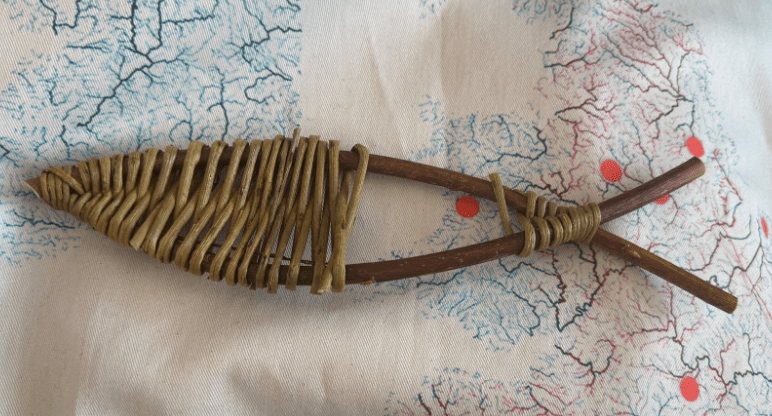
Image: Woven fish by Love Our Ouse, overlaid on Sick River textile map by Lucy Carruthers
Lucy attended the Voices of Water workshop at the Tate Modern, which focused on artistic and community practices for rights of rivers, oceans and bodies of water. Emma Critchley’s collaborative project, Soundings explores care for deep-sea ecosystems and what it means to be custodians of the Ocean. Freshwater community Ecologist Anne Robertson shared research on the biodiversity of groundwater ecosystems and her work with lawyers to improve the water quality of rivers. Carolina Caycedo unfolded her Serpent River Book through the audience, sharing stories of extractivism’s impact on natural and social landscapes in Colombia, Brazil, and Mexico. The community initiative, Love Our Ouse, described their experience of collective action, pioneering the first River Charter supported by a UK Council.
Rendering the Alternative – 9 nights
Sonia E Barrett
Sonia has been working for the past year on this artist commission: Rendering the Alternative – 9 nights. The commission from the City of London asks artists to create an imagined world, one free from the restrictions of Government and Planning Policy, censorship and the narratives of William Beckford and John Cass (18th-century merchants and politicians who furthered and profited from the Slave Trade). Sonia has shown related works in Miami and is working on a small French exhibition, aiming to realise the project fully next year.
 Climate Museum UK